
Wait! Don’t Go Yet! 👋
We see you eyeing those adorable outfits! 😍 Before you leave, here’s 10% OFF your first order!
Hurry, your little one’s next favorite outfit is waiting! 🛍️✨
The American Mah Jongg card is a menu of winning hands. Your goal is to build one complete line exactly as printed—not a mixture of pieces from different lines.
Use the current card issued for your group. Sections and examples change from year to year, so learn the card’s visual language instead of memorizing one season’s hands.
The card groups hands into families such as year hands, consecutive runs, odd or even numbers, winds and dragons, and singles and pairs. Section names help you scan, but the printed line—not the section title—controls the winning pattern.
Spaces divide a line into groupings. A grouping may be a single, pair, Pung, Kong, Quint, or another pattern allowed by the card. Count all positions: a complete American Mah Jongg hand normally contains 14 tiles.
Common shorthand includes:
Parentheses contain instructions. Read them before choosing the hand; they may specify suit relationships, number choices, or which grouping varies.
Printed colors do not automatically mean Craks, Bams, or Dots. They show how suits relate within that line:
Dragons follow their matching suits under standard play: Red with Craks, Green with Bams, and White with Dots. Always follow any special instruction printed on the current card.
The letter at the end of a line describes how the hand must be played:
X does not mean “the same number.” Repeated numbers and parenthetical directions show number relationships.
Before committing, ask:
Then compare the line with your rack. For help identifying tile families, review Get to Know the Tiles. Next, learn How to Choose a Hand as a Beginner and revisit Master the Charleston.
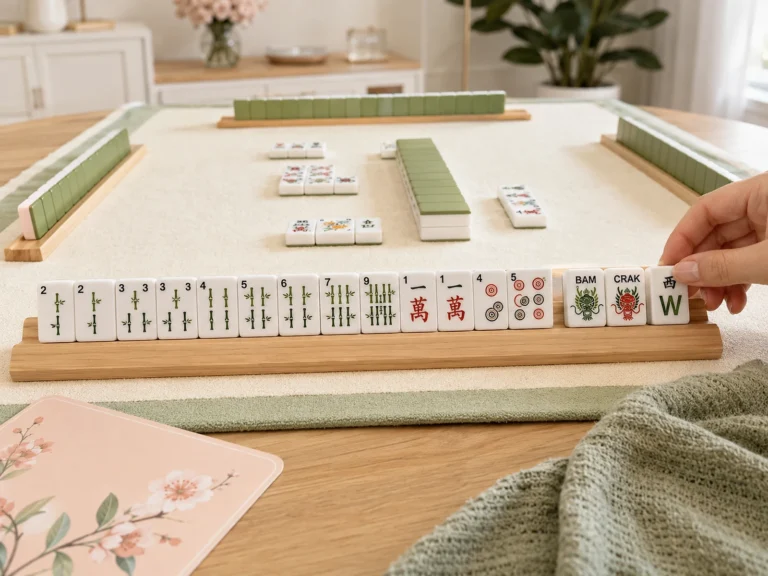
Practicing with a clear, easy-to-read set makes card-to-tile matching much faster. Browse American Mahjong tile sets when you are ready to build your table.
Next: How to Choose a Hand as a Beginner
Rules note: Card wording, house procedures, and tournament rules may differ. Use the current official card and the rules governing your game. This guide does not reproduce any complete annual card hand.