
Wait! Don’t Go Yet! 👋
We see you eyeing those adorable outfits! 😍 Before you leave, here’s 10% OFF your first order!
Hurry, your little one’s next favorite outfit is waiting! 🛍️✨
Opening a new American Mah Jongg set can feel a little overwhelming. There are colorful symbols, unfamiliar characters, Flowers, Winds, Dragons, and—unlike many other versions of mahjong—Jokers.
The good news is that the system becomes much easier once you sort the tiles into a few simple groups. A standard American Mah Jongg game uses 152 tiles: three numbered suits, Winds, Dragons, Flowers, and Jokers.
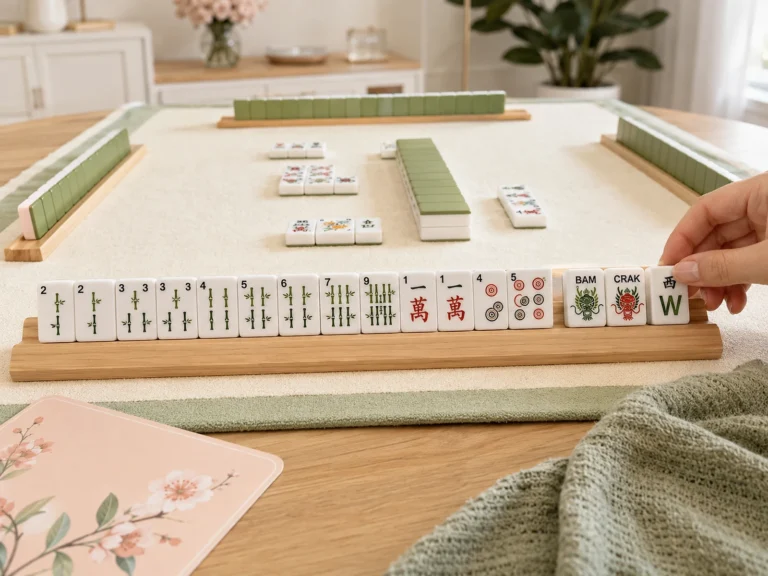
American Mah Jongg has three suits. Each suit contains tiles numbered 1 through 9, with four copies of each number.
Dots are decorated with circles. The number of circles generally shows the number of the tile, although the artwork may be highly stylized on modern sets.
There are 36 Dot tiles in total: four copies each of 1 Dot through 9 Dot.
Bams is short for bamboos. Most Bam tiles display bamboo-like lines. The 1 Bam is the exception—it is traditionally represented by a bird and may look very different from the other Bams.
There are 36 Bam tiles: four copies each of 1 Bam through 9 Bam.
Craks is short for characters. These tiles often include a Chinese character together with a Western number. Beginner-friendly American sets usually print the Arabic number clearly in a corner.
There are 36 Crak tiles: four copies each of 1 Crak through 9 Crak.
Together, the three suits account for 108 tiles.
There are four Winds:
You receive four copies of each Wind, for a total of 16 Wind tiles. Winds are suitless: a North is not a Dot, Bam, or Crak.
On the card, Winds are usually represented by their first letters: N, E, W, and S. When the card shows “NEWS,” it is asking for one of each Wind in that order.
American Mah Jongg includes three Dragons:
There are four of each, for a total of 12 Dragon tiles.
The White Dragon is often called Soap because many versions look like a blank tile or a simple frame. Soap also represents zero when a hand on the card includes a 0.
Dragons may coordinate with suits. In many hands, the Green Dragon relates to Bams, the Red Dragon relates to Craks, and the White Dragon relates to Dots. Always read the color requirements and notes printed on the current card.
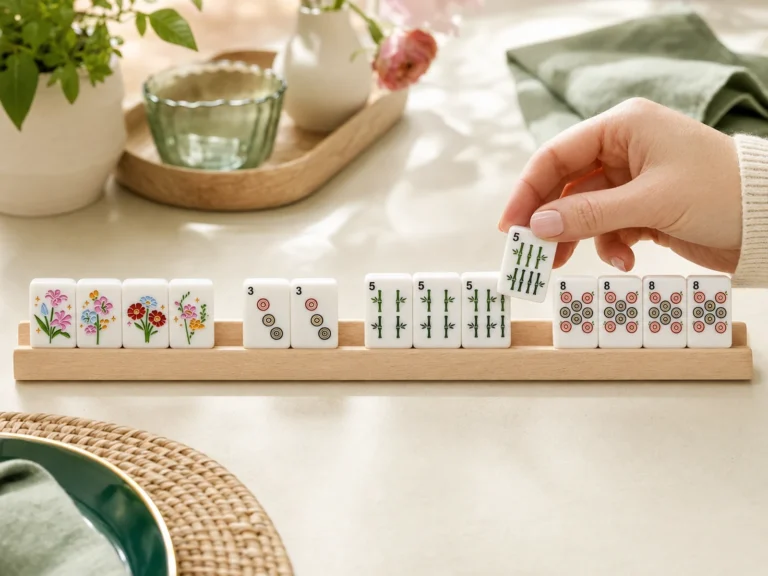
A standard game uses eight Flowers. Their artwork may show flowers, seasons, numbers, or other decorative images.
In American Mah Jongg, the individual pictures and numbers on Flower tiles normally do not create separate identities. Unless the current card states otherwise, all eight Flowers are interchangeable.
Flowers are suitless and are represented by F on the card.
American Mah Jongg uses eight Jokers. A Joker is a wild tile that may replace a natural tile in certain groups.
Jokers can generally be used in:
Jokers cannot generally be used in:
We cover Joker exchanges and restrictions in detail in How to Use Jokers.
| Category | Count | |—|—:| | Dots | 36 | | Bams | 36 | | Craks | 36 | | Winds | 16 | | Dragons | 12 | | Flowers | 8 | | Jokers | 8 | | Total | 152 |
Some retail sets include more than 152 pieces. The extras may be replacement blanks, additional Flowers, or spare Jokers. Separate the standard 152 playing tiles before beginning.
Before your first game, place every tile face up and sort the set into seven groups: Dots, Bams, Craks, Winds, Dragons, Flowers, and Jokers.
Next, practice finding tiles called out by another player:
This five-minute exercise makes the first real game much more comfortable.
Focus on the suit and number before focusing on the artwork. Modern tile sets can be very decorative, but every playable tile still belongs to one of the same basic categories.
A standard American Mah Jongg game uses 152 tiles.
For standard American play, Flowers are normally interchangeable even when their artwork or printed numbers differ.
Many White Dragon designs look like a blank bar of soap or a simple rectangular frame. It is also used as zero in year hands.
No. Jokers are used in groups of three or more identical tiles, not in singles or pairs.
Editor’s note: Exact card interpretations and tournament rules can change. Players should use the current official card and the rules applicable to their table.