
Wait! Don’t Go Yet! 👋
We see you eyeing those adorable outfits! 😍 Before you leave, here’s 10% OFF your first order!
Hurry, your little one’s next favorite outfit is waiting! 🛍️✨
Jokers give American Mah Jongg much of its flexibility—and create many of its most common beginner questions.
A Joker is a wild tile, but it cannot replace absolutely anything. It is used to help complete groups of three or more identical tiles. Understanding that single principle will prevent most Joker mistakes.
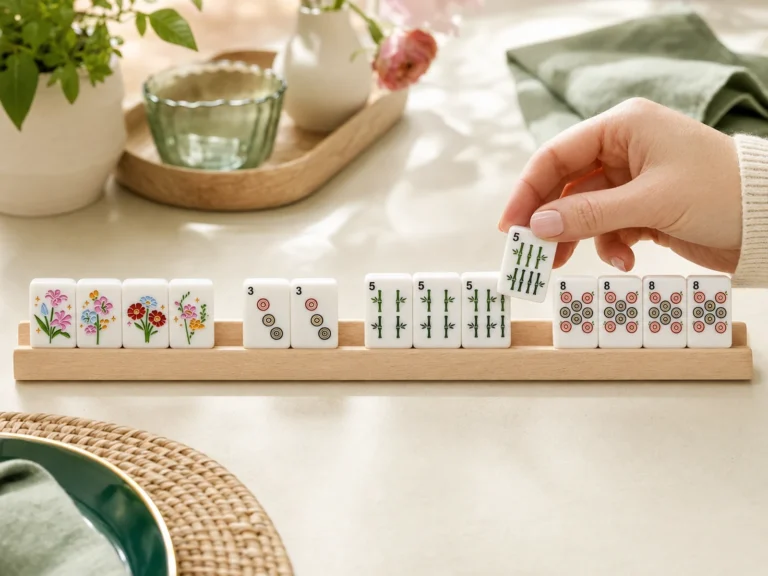
Jokers may generally substitute for natural tiles in:
Suppose your hand needs four 7 Dots. If you have three natural 7 Dots and one Joker, the Joker can complete the Kong.
One group may contain more than one Joker, provided the grouping is otherwise legal under the current card.
Jokers may not generally be used in:
If the card requires a pair of Red Dragons, you need two natural Red Dragons. One Red Dragon plus one Joker is not a legal pair.
The same applies to a single Flower, a single Wind, or any other position that calls for only one tile.
A natural tile is any non-Joker tile.
If a card line calls for a Kong of 5 Bams, the following examples can all form the four-tile group:
Always confirm that the group represents identical tiles. A Joker does not turn unrelated tiles into a legal set.
When you call another player’s discard to complete a Pung, Kong, or Quint, place the full group face up on the top of your rack. This is called an exposure.
Jokers may be included in the exposure when legal. Once exposed, the grouping gives other players information about the hand you may be building.
You cannot call a discarded Joker. Jokers enter your hand through the deal or a normal draw.
If another player has an exposed group containing a Joker and you hold the natural tile represented by that Joker, you may be able to exchange your natural tile for the Joker.
Example:
The exposed group remains the same size and stays legal.
Under common rules, the exchange is made during your turn and should be handled openly so the table can follow what happened.
If you previously exposed a group containing a Joker and later draw the matching natural tile, you may generally replace your own Joker as part of your turn.
The recovered Joker returns to your hand and may be used elsewhere.
When a hand is declared dead, its exposures generally cannot be used for Joker exchanges. Tournament or house procedures may include additional details, so confirm the applicable rule.
A hand marked concealed on the card cannot normally make exposures during play. That does not automatically mean Jokers are forbidden.
Jokers may still be used in legal groups of three or more within a concealed hand unless the card or rule specifies otherwise. The hand must remain concealed until Mah Jongg is declared.
It is illegal and can distract you from finding the natural matching tile you actually need.
A Joker can support many possible hands. Avoid committing it to an exposure too early unless the call significantly improves your position.
When another player exposes a Joker, note the natural tile needed for an exchange. You may draw that tile later.
The natural tile you give away becomes visible in the exposure. Although the exchange gains a Joker, it may reveal information about your direction or help you confirm what another player is building.
Knowing how many Jokers are exposed, discarded incorrectly under a house situation, or already in your rack helps you judge whether a Joker-dependent hand is realistic.
Jokers may not be passed during the Charleston or courtesy pass.
Pairs must be natural.
A Joker cannot be claimed from the discard area.
Make Joker exchanges during the permitted part of your turn according to the rules being used.
The replacement must be the exact tile the Joker represents in that exposure.
Yes, a legal Pung, Kong, or Quint may generally contain multiple Jokers.
Only when the Flowers form a legal group of three or more identical/interchangeable Flowers. A Joker cannot replace a single Flower or complete a pair of Flowers.
No. A discarded Joker cannot be called.
They may be used in legal groups of three or more, but the hand must follow all concealed-hand restrictions.
Multiple exchanges may be possible when you hold the exact natural replacements and follow the timing rules applicable to the game. Confirm with the current rules or tournament procedure.
Editor’s note: This guide summarizes common American Mah Jongg practice. Always refer to the current official card and rules used by your teacher, host, league, or tournament.