

Wait! Don’t Go Yet! 👋
We see you eyeing those adorable outfits! 😍 Before you leave, here’s 10% OFF your first order!
Hurry, your little one’s next favorite outfit is waiting! 🛍️✨
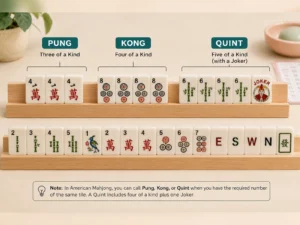
Calling lets you claim another player’s discard, but only for a legal purpose. A call is useful because it completes a needed group; it is costly because the exposure reveals information about your hand. When You May Call Under standard rules, you may call the most recent discard to complete a group of three or more identical tiles required by your card line: You generally may not call simply to create a single or pair. You may call any needed tile—including one completing a single or pair—when it gives you a valid Mah Jongg immediately. How to Complete a Call Play then continues from you, which may skip players who were between the discarder and claimant. Using Jokers in an Exposure Jokers may substitute in groups of three or more identical tiles, but not in singles or pairs. A discard itself cannot be a Joker because discarded Jokers cannot be claimed. Learn the full exchange rules in How to Use Jokers. Calls and Concealed Hands If your target line is marked C, do not expose a grouping. A concealed hand generally may call only the final tile that completes Mah Jongg. Lines marked X permit legal exposures. Review Exposed vs. Concealed…
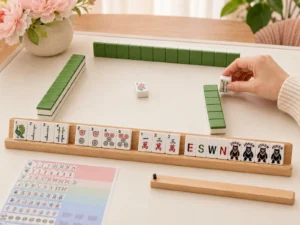
Most turns follow one calm rhythm: draw, evaluate, and discard. Learning that rhythm keeps the table moving and prevents accidental extra or missing tiles. Before Normal Turns Begin After the deal and Charleston, East begins play with 14 tiles and makes the opening discard. Other players normally begin their turns with 13 concealed tiles. American Mah Jongg play proceeds counterclockwise. A claimed discard can change who acts next because play continues from the claimant. The Standard Turn After the discard is released and named, your turn ends. The next player draws unless someone makes a legal call. Keep the Tile Count Straight During decision time after drawing, you usually hold 14 tiles. After discarding, you return to 13. Exposed sets remain part of your hand, so include them when checking your total. If your rack count seems wrong, stop and ask the table before taking another action. Do not quietly draw or discard to repair it. What If Someone Calls the Discard? A player may call a discard to complete an eligible grouping, such as a Pung, Kong, or Quint, or to complete Mah Jongg. The claimant displays the legal grouping and then discards, unless the call completes the game.…
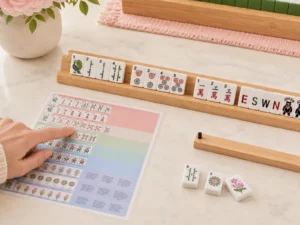
Choosing a hand is not a single decision made after the deal. It is a process of narrowing the card as your tiles change. Begin by reading the current card correctly. If its notation still feels unfamiliar, start with How to Read the American Mah Jongg Card. Step 1: Inventory the Hard-to-Rebuild Tiles Look first for assets that are difficult to replace: Do not count only how many tiles fit. A pair or rare natural tile may be more valuable than several unrelated singles. Step 2: Shortlist Card Sections Use what your rack already does well. Many odd numbers suggest scanning odd-number hands. Several consecutive tiles suggest run-based sections. Multiple Winds or Dragons justify checking those families. A dominant suit may favor a one-suit or suit-heavy option. Step 3: Keep Two Nearby Options Choose a primary hand and a backup that share several needed tiles. If both use your Flowers, pair, and main suit, Charleston passes and early draws can support either direction. Avoid selecting two hands with almost no overlap. That is not flexibility; it is two unrelated shopping lists. Step 4: Count Distance, Not Hope For each candidate, count the missing natural requirements, especially singles and pairs where…
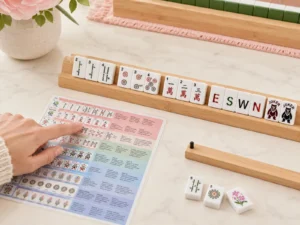
The American Mah Jongg card is a menu of winning hands. Your goal is to build one complete line exactly as printed—not a mixture of pieces from different lines. Use the current card issued for your group. Sections and examples change from year to year, so learn the card’s visual language instead of memorizing one season’s hands. Start with the Sections The card groups hands into families such as year hands, consecutive runs, odd or even numbers, winds and dragons, and singles and pairs. Section names help you scan, but the printed line—not the section title—controls the winning pattern. Read Each Line from Left to Right Spaces divide a line into groupings. A grouping may be a single, pair, Pung, Kong, Quint, or another pattern allowed by the card. Count all positions: a complete American Mah Jongg hand normally contains 14 tiles. Common shorthand includes: Parentheses contain instructions. Read them before choosing the hand; they may specify suit relationships, number choices, or which grouping varies. Colors Show Suit Relationships Printed colors do not automatically mean Craks, Bams, or Dots. They show how suits relate within that line: Dragons follow their matching suits under standard play: Red with Craks, Green with…
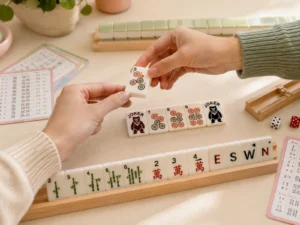
Jokers give American Mah Jongg much of its flexibility—and create many of its most common beginner questions. A Joker is a wild tile, but it cannot replace absolutely anything. It is used to help complete groups of three or more identical tiles. Understanding that single principle will prevent most Joker mistakes. Where Jokers May Be Used Jokers may generally substitute for natural tiles in: Suppose your hand needs four 7 Dots. If you have three natural 7 Dots and one Joker, the Joker can complete the Kong. One group may contain more than one Joker, provided the grouping is otherwise legal under the current card. Where Jokers May Not Be Used Jokers may not generally be used in: If the card requires a pair of Red Dragons, you need two natural Red Dragons. One Red Dragon plus one Joker is not a legal pair. The same applies to a single Flower, a single Wind, or any other position that calls for only one tile. Natural Tiles and Joker Groups A natural tile is any non-Joker tile. If a card line calls for a Kong of 5 Bams, the following examples can all form the four-tile group: Always confirm that the…
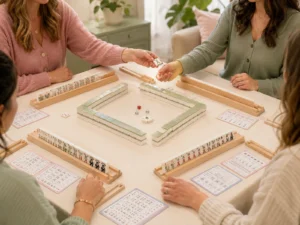
The Charleston is one of the features that makes American Mah Jongg unique. Before normal play begins, every player passes unwanted tiles in a coordinated sequence. The goal is not simply to get rid of bad tiles. The Charleston helps you shape your hand, discover possible card lines, and gather information from the tiles moving around the table. Before You Begin Each player should have: East sets aside the extra tile temporarily while everyone completes the passing sequence. The most important rule to remember is simple: Never pass a Joker during the Charleston. The First Charleston The first Charleston consists of three mandatory passes. Every player passes exactly three tiles each time. The order is: A common memory aid is: Right, Across, Left — RAL. Place the three selected tiles face down and move them together. Do not reveal them to other players. The Optional Second Charleston After the first Charleston, players may complete a second Charleston if everyone agrees. The order reverses: Memory aid: Left, Across, Right — LAR. Because the second Charleston is optional, confirm clearly whether the table is continuing. House and tournament procedures can differ regarding how the decision is made. What Is a Blind Pass?…
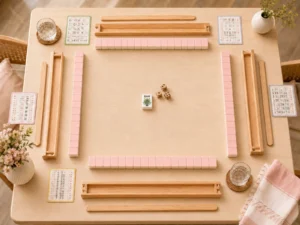
Once you know the tiles, it is time to prepare the table. American Mah Jongg setup may look elaborate, but the same routine is repeated before every game. You need four players, a complete tile set, four racks with pushers, two dice, and a current American Mah Jongg card for each player. What You Need A mat is optional, but it protects the table, reduces noise, and makes the tiles easier to move. Step 1: Check and Mix the Tiles Make sure the playing set contains the standard 152 tiles. Turn all tiles face down in the center of the table and mix them thoroughly with both hands. This mixing process is sometimes called “washing” the tiles. Keep every tile face down so no player can identify a tile before the deal. Step 2: Choose Seats and East One player begins as East, also called the dealer. Tables use several accepted methods to choose East, including rolling dice or randomly selecting Wind tiles. The remaining players sit around the table as South, West, and North. Follow the method used by your teacher, host, or regular group. East begins with one additional tile and makes the first discard after the Charleston.…
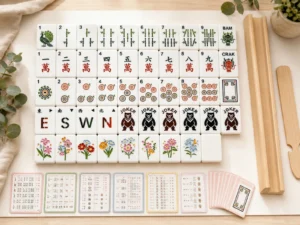
Opening a new American Mah Jongg set can feel a little overwhelming. There are colorful symbols, unfamiliar characters, Flowers, Winds, Dragons, and—unlike many other versions of mahjong—Jokers. The good news is that the system becomes much easier once you sort the tiles into a few simple groups. A standard American Mah Jongg game uses 152 tiles: three numbered suits, Winds, Dragons, Flowers, and Jokers. The Three Numbered Suits American Mah Jongg has three suits. Each suit contains tiles numbered 1 through 9, with four copies of each number. Dots Dots are decorated with circles. The number of circles generally shows the number of the tile, although the artwork may be highly stylized on modern sets. There are 36 Dot tiles in total: four copies each of 1 Dot through 9 Dot. Bams Bams is short for bamboos. Most Bam tiles display bamboo-like lines. The 1 Bam is the exception—it is traditionally represented by a bird and may look very different from the other Bams. There are 36 Bam tiles: four copies each of 1 Bam through 9 Bam. Craks Craks is short for characters. These tiles often include a Chinese character together with a Western number. Beginner-friendly American sets usually…